Roy Lichtenstein:
Roy Lichtenstein born October 27, 1923, in New York City was one of the most influential and pioneering artists of the second half of the twentieth century. He is largely identified with Pop Art, a movement he helped create, and his first fully achieved paintings were based on imagery from comic strips and advertisements and reduced in a style imitating thecrude printing processes of newspaper reproduction. These paintings revived the American art scene and altered the history of modern art.
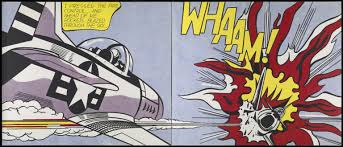
In the late 1940s and early 1950s, Lichtenstein had begun working in series and his iconography was drawn from printed images. His first sustained theme, intimate paintings and prints in the vein of Paul Klee that poked lyrical fun at medieval knights, castles and maidens, may well have been inspired by a book. Lichtenstein then took an ironic look at nineteenth-century American genre paintings he saw in history books, creating Cubist interpretations of cowboys and Indians.
Lichtenstein started to gravitate towards what he would characterize as the “dumbest” or “worst” visual item he could find and then went on to alter or improve it. In the 1960s, commercial art was considered beneath contempt by the art world. in early 1950s, with the rise of Abstract Expressionism, nineteenth-century American narrative and genre paintings were at the base of their reputation among critics and collectors. The paraphrasing of hated images, became a principal feature of Lichtenstein’s art. Well before finding his signature mode of expression in 1961, Lichtenstein called attention to the lie of conventions and taste that permeated art and society.

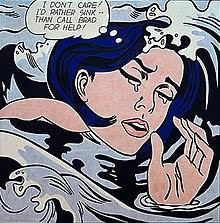


With the advent of critical and commercial success, Lichtenstein made significant changes in his life and continued to investigate new possibilities in his art. Wanting to grow, Lichtenstein turned away from the comic book subjects that had brought him fame. In the late 1960s his work became less narrative and more abstract, as he continued to reflect on the nature of the art enterprise itself. He beganto explore and deconstruct the notion of brushstrokes. Brushstrokes are traditionally conceived as vehicles of expression, but Lichtenstein made them into a subject. Modern artists have typicallymaintained that the subject of a painting is painting itself. Lichtenstein took this idea one imaginative step further.
Another entire display of works produced during the 1970s were complex encounters with Cubism, Futurism, Purism, Surrealism and Expressionism. Lichtenstein expanded his palette beyond red, blue, yellow, black, white and green, and invented and combined forms. He was not just isolating found images, but juxtaposing, overlapping, fragmenting and recomposing them. In the early 1980s, which accorded with re-establishing a studio in New York City, Lichtenstein was also at the top of a busy mural career.
Art had carried references to popular culture throughout the 20th century, but in Lichtenstein’s works the styles, subject matter, and techniques of reproduction common in popular culture appeared to dominate the art. This marked a major shift away from Abstract Expressionism. Lichtenstein’s inspirations came from the culture at large and suggested little of the artist’s individual feelings.
Although, in the early 1960s, Lichtenstein was often casually accused of just copying his pictures from cartoons, his method involved some considerable alteration of the source images. The extent of those changes, and the artist’s basis for introducing them, has long been central to discussions of his work, as it would seem to indicate whether he was interested above all in producing pleasing, artistic compositions, or in shocking his viewers with the garish impact of popular culture. Lichtenstein’s emphasis on methods of mechanical reproduction, particularly through his signature use of Ben-Day dots, highlighted one of the central lessons of Pop art, that all forms of communication, all messages, are filtered through codes or languages. Arguably, he learned his appreciation of the value of codes from his early work, which drew on an eclectic range of modern painting.
References:
The Art Story. (n.d.). Roy Lichtenstein Paintings, Bio, Ideas. [online] Available at: https://www.theartstory.org/artist-lichtenstein-roy.htm [Accessed 30 Mar. 2019].
Lichtensteinfoundation.org. (n.d.). Roy Lichtenstein Foundation – Roy Lichtenstein Foundation. [online] Available at: https://lichtensteinfoundation.org [Accessed 30 Mar. 2019].
The Museum of Modern Art. (n.d.). Roy Lichtenstein | MoMA. [online] Available at: https://www.moma.org/artists/3542 [Accessed 30 Mar. 2019].
Artnet.com. (n.d.). Roy Lichtenstein | artnet. [online] Available at: http://www.artnet.com/artists/roy-lichtenstein/ [Accessed 30 Mar. 2019].
Wes Wilson:
Graphic artist Wes Wilson pioneered the rock concert poster aesthetic of the late ’60s, translating the sights and sounds of counterculture society into the psychedelic iconography that stands today among the era’s most lasting images.Wilson was one of the best-known designers of psychedelic posters. He invented a style that is now synonymous with the peace movement, psychedelic era, and the 1960s. In particular, he is known for inventing and popularizing a psychedelic font around 1966 that made the letters look like they were moving or melting.

Wilson was very aware of the social and political events of the early 1960s. Alarmed by illegal FBI wiretaps on civil rights leaders and the escalating military activity in Vietnam, in late 1965 he designed a full-colour poster that warned of America adopting the policies of a dictatorship. He had also designed his wedding invitation.
Stylistically, posters of that Late Modern era were generally simple and neat. They were composed of a few basic elements — image and lettering — on a plain background, and they were produced by the most modern technical methods of the graphic industry. Socially and aesthetically, the counter culture was the contrast of the 1960s mainstream sensibilities. Like the music, the poster art was an underground, minimal budget. It was usually made at home or, later, in cluttered, informal studios.
The psychedelic movement began in the mid 1960’s and had an effect, not just on music, but also on many aspects of popular culture. This included style of dress, language and the way people spoke, art, literature and philosophy.
The name “psychedelic” refers to drugs that were popular with the youth culture of the time. Posters for rock concerts tried to visually express the feeling of tripping out. The visual motifs of psychedelic art include Art Nouveau-inspired wavy shapes, illegible hand-drawn type, and intense optical colour vibration inspired by the pop art movement.
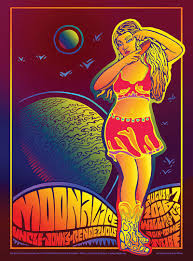
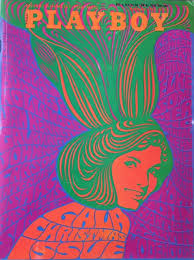


The end of WWII in 1945 brought about a post-war economic boom in the U.S. It also brought about an enormous spike in the birth rate, known as “the baby boom.” Between 1945 and 1957 nearly 76 million babies were born in America. By the middle 1960s, most of these kids were young adults. These “baby boomers” questioned America’s materialism and conservative cultural and political standards. During the 1960s a youth movement emerged, seeking to create a democratic society free from discrimination. The feminist movement and the Black movement are a direct result of this evolution.
Americans in the 1960s and 70s addressed many controversial issues; from civil rights, the Vietnam War, nuclear proliferation, and the environment to drug use, sexual freedom, and nonconformity. Many youth wanted spiritual experiences through Eastern Spirituality and psychedelic drugs.
References:
AllMusic. (n.d.). Wes Wilson | Biography & History | AllMusic. [online] Available at: https://www.allmusic.com/artist/wes-wilson-mn0001616809 [Accessed 30 Mar. 2019].
Wes Wilson. (n.d.). Wes Wilson. [online] Available at: http://www.wes-wilson.com [Accessed 30 Mar. 2019].
Unwin, N. (2019). The Art of Influence: Wes Wilson | Comet Creative. [online] Comet Creative. Available at: https://wearecomet.com/1960s-psychedelic-tribute-calendar-wes-wilson/[Accessed 30 Mar. 2019].
Graphic Design History. (n.d.). Psychedelic 60s. [online] Available at: https://visualartsdepartment.wordpress.com/psychedelic-60s/ [Accessed 30 Mar. 2019].
 Design | Photography | Webdesign |